Heavy Haul Service
On-Site Heavy Transport
Within-facility heavy moves — refinery turnarounds, plant revamps, and module placement.
When the haul ends at the gate but the move doesn’t
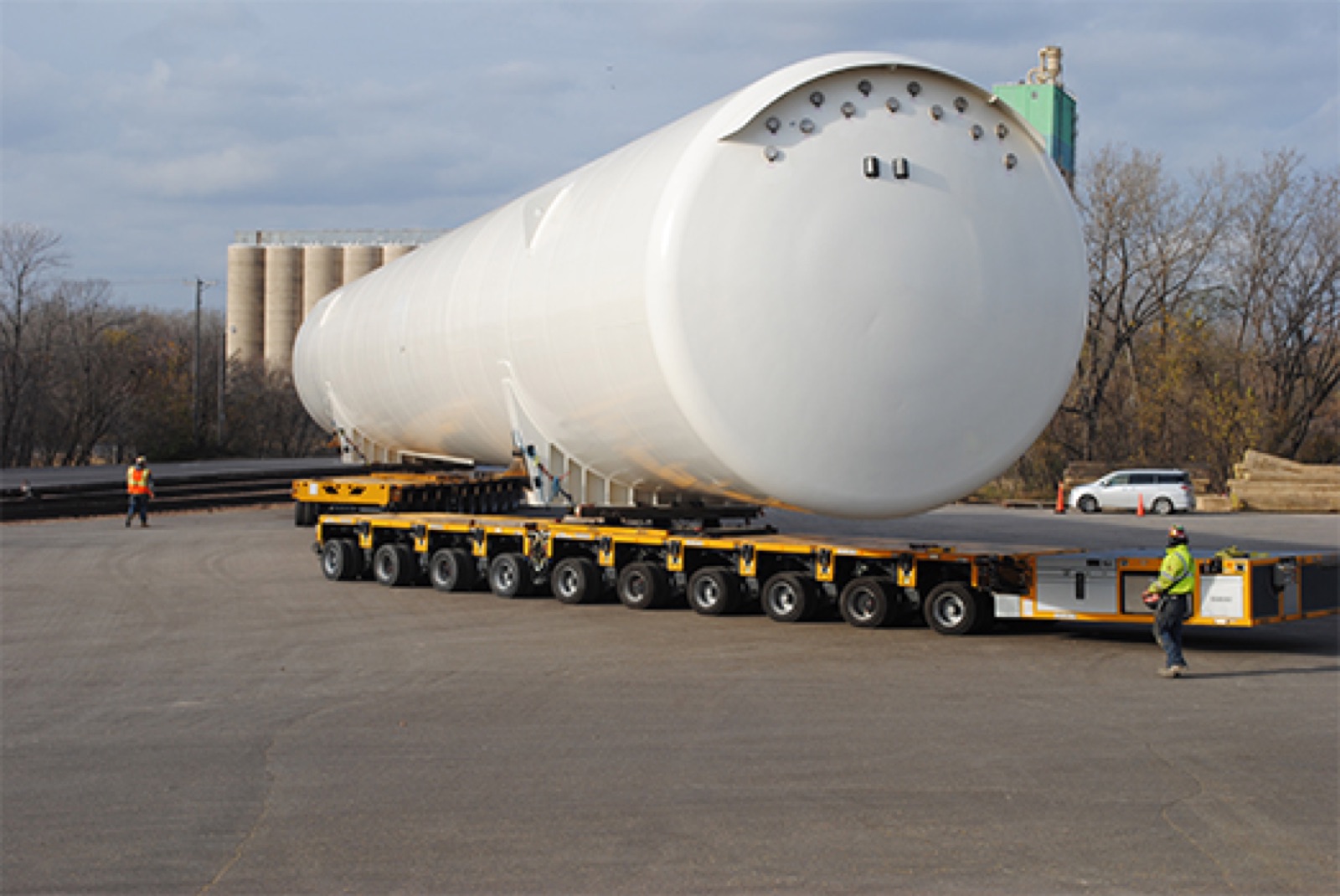
Most industrial cargo arrives at the plant gate on a road-legal trailer. From there, the load often has to travel further: across the yard, between operating units, through a building opening, onto its foundation. Standard tractors and trailers can’t make those moves — but our SPMTs, hydraulic platform trailers, and on-site crews can.
Where this work happens
- Refinery turnarounds — replacement vessels, exchangers, columns, reactors
- Power plant outages — transformer, generator, and turbine swaps
- Chemical plant revamps — modular skid placement
- Manufacturing plants — heavy machinery installation and relocation
- Construction sites — module and prefab placement at final position
- Wind farms — nacelle and rotor staging at turbine pads
Equipment we use on-site
- SPMTs — for the heaviest and most complex moves
- Hydraulic platform trailers — when self-propulsion isn’t required
- Cranes and rigging — for lifts before, during, and after the on-site move
- Jack and slide — for the final placement when access is restricted
How we plan an on-site move
- Site survey — measure clearances, evaluate roads and pad capacity, identify restricted zones
- Route plan — turn radii, overhead clearances, ground bearing, weight restrictions
- Coordination with site operations — hot-work, LOTO, security, escort
- Pre-job briefing — full crew plus site safety
- Execution — move performed under continuous radio comms with the site
- Closeout — post-move walk-down, documentation handoff
What you should have ready
- Site drawings — plot plan with grade, clearances, obstructions
- Cargo specs — weight, LWH, lift points
- Origin and destination — within the facility
- Schedule constraints — including any operating-area shutdown windows
- Site safety requirements — orientation, badging, escort policy
Plan an on-site move › or call 24/7 dispatch: 405-506-1850
Frequently asked questions
What is on-site transport?
On-site (or in-plant) transport is heavy moving that takes place inside an industrial facility — between buildings, around live equipment, into a structure, or to a final foundation. Equipment used is similar to over-the-road heavy haul but operated under different rules: tighter clearances, plant safety procedures, and often coordination with operating units that can't be shut down.
When do I need on-site transport instead of just unloading the truck on a pad?
When the cargo arrives at a yard or staging area and still has a long way to go before final position — through plant gates, around live process units, between buildings, into a structure. The over-the-road tractor and trailer typically can't navigate that final segment.
Can you work in operating refineries?
Yes — routinely. We follow site-specific safety procedures, attend orientation, work under the site's hot-work and lockout-tagout standards, and coordinate with site operations on schedule windows.
How do on-site moves differ from cranes or jack and slide?
On-site transport carries the load horizontally over distance. Cranes lift vertically. Jack and slide places loads in tight final positions. A complete plant revamp often uses all three — heavy haul brings cargo to the gate, on-site transport carries it through the plant, jack and slide places it in the final position.
24/7 Dispatch · Nationwide
Tell us what you need to move.
One call covers the crane, the haul, and the logistics. We’ll spec the crew, the equipment, and the route — and put a written quote in your hands.
Request a Quote 24/7 Dispatch Lines
- Crane & Rigging405-373-2979
- Heavy Haul405-506-1850
- Bulk Logistics405-506-1869