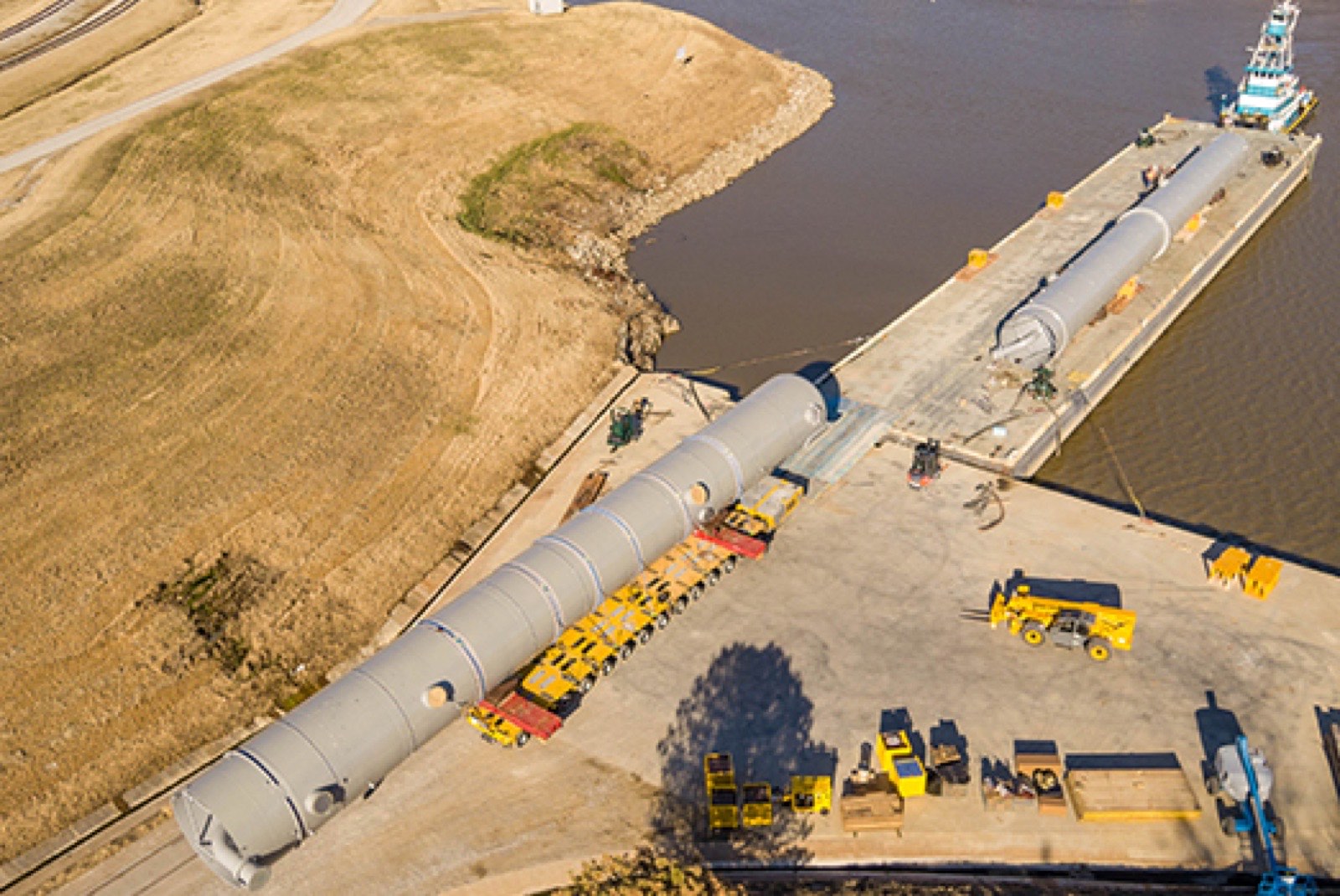
Heavy Haul Service
Roll-On / Roll-Off Heavy Cargo Services
Move cargo between barge, rail, fabrication yard, and final destination using SPMTs and hydraulic platform trailers.
When rolling beats lifting
For the largest cargo, rolling is often safer, faster, and cheaper than lifting. A 1,500-ton module that would require a multi-crane lift can roll onto an SPMT in a fraction of the time, with less rigging risk and no crane setup.
Where we do RoRo work
- Barge-to-land — heavy modules and components arriving by water
- Rail-to-truck — bulky project cargo transitioning from rail
- Fabrication yard to truck or barge — outbound from fabricator
- Truck or barge to job site — final-destination delivery
- Yard-to-yard — within and between staging facilities
What we use
- SPMTs — the primary tool for RoRo
- Hydraulic platform trailers — towed alternatives where self-propulsion isn’t needed
- Ramps, transition plates, and approach-grade preparation
What planning looks like
- Cargo data — weight, dimensions, lift points, center of gravity
- Origin / destination geometry — barge ramp, rail siding, fab-yard exit, pad approach
- Tide windows (for barge work) — coordinated with marine carrier
- SPMT or trailer configuration — axle lines and bolster setup
- Approach prep — pad grading, ramp installation, transition plates
- Move plan — dry runs, communications protocol, contingencies
Coordination with marine carriers, railroads, and fabricators
Most RoRo work is the seam between two transportation modes. Our routing team coordinates with the upstream and downstream carriers — barge captains, terminal managers, railroad hubs, and fabricators — so the handoff is clean.
Plan a roll-on / roll-off move › or call 24/7 dispatch: 405-506-1850
Frequently asked questions
What is roll-on / roll-off in heavy haul?
Roll-on / roll-off (RoRo) is a method of loading and unloading large cargo by rolling it on or off a barge, rail car, or trailer using self-propelled or towed transporters — instead of lifting it with a crane. It's typically used when the cargo is too heavy, too large, or too fragile for a crane lift, or when the geometry doesn't allow one.
When do I need roll-on / roll-off instead of a crane lift?
When the cargo exceeds practical crane capacity, when there's no place to set up a crane that can reach the lift point, when the cargo can't be slung safely, or when barge-to-land or rail-to-truck logistics make rolling more efficient than lifting twice.
Do you handle the barge or vessel side, or just the land side?
We handle the land side — moving cargo on or off the barge using our SPMTs or hydraulic trailers, including the ramp and tide-window planning. The vessel itself is provided by your marine carrier; we coordinate.
24/7 Dispatch · Nationwide
Tell us what you need to move.
One call covers the crane, the haul, and the logistics. We’ll spec the crew, the equipment, and the route — and put a written quote in your hands.
Request a Quote 24/7 Dispatch Lines
- Crane & Rigging405-373-2979
- Heavy Haul405-506-1850
- Bulk Logistics405-506-1869